
Established 2005 Registered Charity No. 1110656
Scottish Charity Register No. SC043760
DONATE
RECENT TWEETS
Art as hope, art as expression and art as a catalyst for change. Thoughts by André Rostant
During May, I had the good fortune to take part in various art workshops open to, one expressly for, homeless people in London. Our editor, Jake, invited me along to a session at The Museum of Homelessness in Finsbury Park. We painted t-shirts and would have made cyanotype prints, but for the overcast day.
On the back of several projects the two of us had attended, Jake and I wrote a piece in Big Issue about the general collapse of arts funding, and the disproportionate knock-on effects for the socially disadvantaged, especially homeless people. I co-wrote the article, but should like to expand on it here with a particular emphasis on the visual arts, like painting and sculpting.
I noted that for many people experiencing homelessness, worklessness or social isolation, art sessions provided by councils and charities are a lifeline: one participant told me outright that art like this had saved his life. These are precious opportunities for self-expression.
In the Big Issue article, we listed the various styles of workshop – some supervised, some do-as-you-will, some even offering film-making. One I visited at St Mellitus Church, Islington, was part of a broader event, with mobile chest-screening, health advice, council services advisors, a barber, a hand-cleaning and manicure specialist and a singing workshop.
This way of fostering, of cultivating artists, challenges perceptions – we don’t stop being creative just because circumstance piles up on us; art is a primordial urge. Even before the so-called dawn of civilisation, people painted cave walls, carved ivory, danced, sang, made instruments. Nor can we escape the fact that much ancient primitive art arises from attempts to understand the nature of our world. The ceiling of the Sistine Chapel is far from humanity’s first attempt to express our cosmic interconnectedness.
Art has often been a vehicle of resistance: Picasso’s work, for example, threw a daring mirror up to Francisco Franco’s Spain. Zuloaga, on the other hand, painted flattering portraits of the dictator for propaganda, which was no less art. Dali’s work and relationship with el Caudillo (Franco) was more ambiguous… Was there an irony, a mocking element to his apparent enthusiasm for Franco’s vicious fascism?
In 1962, American artist Andy Warhol exhibited faithfully painted reproductions of Campbell’s Soup labels, bringing into question the whole accepted societal understanding of what constitutes art. Over 60 years later, nobody has yet fully explored what those labels tell us.
Which brings me to ask, what does all the art made by poor people in all these carefully curated spaces say? Themes emerge: seeking, fostering self-expression, challenging perceptions of social exclusion, of homelessness. One organisation works “to bring positive change to people, projects and policy in the homelessness community through arts and creativity.” One charity, to “educate on homelessness.” Another claims it is “empowering people through arts and recovery.” It being implicit that the therapeutic value of art is a given. The broad motif is a petition for inclusion, rather than an assertion of equality.
Amid these slogans about empowerment and delight at revealing the vision and cleverness of the poor to some imagined, unaware mainstream society, there are shades of “Am I Not a Man and a Brother?”, a patronised, subdued embodiment of impotence. What right-thinking person in this world does not fully understand that art can come from anybody anywhere? Nor is this solely a theatre of do-gooders – we ourselves are trained to plead for what we should claim as a right. Art in this context seems to me to be a sublimation, a taming of Banksy proportions. Perceptions are merely massaged.
Art can loom from gable ends in Northern Ireland, blur by on graffiti-smattered trains, fester on toilet walls. Art is rows of empty shoes on cobbled streets, and it stops there. The arbitrary boundaries of art are to be found everywhere expression spills over into overt challenge. Nothing too challenging is art until it can be framed as non-threatening representation. Serrano’s Piss Christ would have had him burned at the stake 300 years ago. Now, since it no longer appeals to disorder, it wins prizes. Ditto, Hurst’s dismembered cow.
“Pigs” scrawled on a wall, depictions of people as rats or as rapists, beheading videos, snuff movies are painful, horrific, damaging and emphatically disqualified as art. Yet, albeit grotesque, they are clearly expressions of self. Fear it as we may, nasty people make art too.
Given that half the world’s population lives in poverty, and a huge number of the remainder in comparative poverty, our art is, anyway, the real mainstream. The projects I visited are invaluable, but only in the context of broader, more kinetic resistance can they hope to truly bring about change.
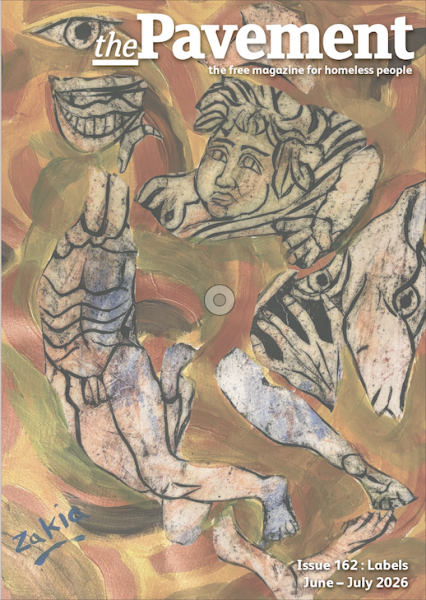
June – July 2026 : Labels
CONTENTS
BACK ISSUES
- Issue 162 : June – July 2026 : Labels
- Issue 161 : April – May 2026 : Working together
- Issue 160 : February – March 2026 : Progress
- Issue 159 : December 2025 – January 2026 : Resolutions
- Issue 158 : October – November 2025 : Making a difference
- Issue 157 : August – September 2025 : Caring about care
- Issue 156 : June – July 2025 : Resilience
- Issue 155 : April – May 2025 : Second Chances
- Issue 154 : February – March 2025 : Time
- Issue 153 : December 2024 – January 2025 : Solidarity
- Issue 152 : October – November 2024 : Change
- Issue 151 : August – September 2024 : Being Heard
- Issue 150 : June – July 2024 : Reflections
- Issue 149 : April – May 2024 : Compassion
- Issue 148 : February – March 2024 : The little things
- Issue 147 : December 2023 – January 2024 : Next steps
- Issue 146 : October 2023 – November 2023 : Kind acts
- Issue 145 : August 2023 – September 2023 : Mental health
- Issue 144 : June 2023 – July 2023 : Community
- Issue 143 : April 2023 - May 2023 : Hope springs
- Issue 142 : February 2023 - March 2023 : New Beginnings
- Issue 141 : December 2022 - January 2023 : Winter Homeless
- Issue 140 : October - November 2022 : Resolve
- Issue 139 : August - September 2022 : Creativity
- Issue 138 : June - July 2022 : Practical advice
- Issue 137 : April - May 2022 : Connection
- Issue 136 : February - March 2022 : RESPECT
- Issue 135 : Dec 2021 - Jan 2022 : OPPORTUNITY
- Issue 134 : September-October 2021 : Losses and gains
- Issue 133 : July-August 2021 : Know Your Rights
- Issue 132 : May-June 2021 : Access to Healthcare
- Issue 131 : Mar-Apr 2021 : SOLUTIONS
- Issue 130 : Jan-Feb 2021 : CHANGE
- Issue 129 : Nov-Dec 2020 : UNBELIEVABLE
- Issue 128 : Sep-Oct 2020 : COPING
- Issue 127 : Jul-Aug 2020 : HOPE
- Issue 126 : Health & Wellbeing in a Crisis
- Issue 125 : Mar-Apr 2020 : MOVING ON
- Issue 124 : Jan-Feb 2020 : STREET FOOD
- Issue 123 : Nov-Dec 2019 : HOSTELS
- Issue 122 : Sep 2019 : DEATH ON THE STREETS
- Issue 121 : July-Aug 2019 : INVISIBLE YOUTH
- Issue 120 : May-June 2019 : RECOVERY
- Issue 119 : Mar-Apr 2019 : WELLBEING
- Issue 118 : Jan-Feb 2019 : WORKING HOMELESS
- Issue 117 : Nov-Dec 2018 : HER STORY
- Issue 116 : Sept-Oct 2018 : TOILET TALK
- Issue 115 : July-Aug 2018 : HIDDEN HOMELESS
- Issue 114 : May-Jun 2018 : REBUILD YOUR LIFE
- Issue 113 : Mar–Apr 2018 : REMEMBRANCE
- Issue 112 : Jan-Feb 2018
- Issue 111 : Nov-Dec 2017
- Issue 110 : Sept-Oct 2017
- Issue 109 : July-Aug 2017
- Issue 108 : Apr-May 2017
- Issue 107 : Feb-Mar 2017
- Issue 106 : Dec 2016 - Jan 2017
- Issue 105 : Oct-Nov 2016
- Issue 104 : Aug-Sept 2016
- Issue 103 : May-June 2016
- Issue 102 : Mar-Apr 2016
- Issue 101 : Jan-Feb 2016
- Issue 100 : Nov-Dec 2015
- Issue 99 : Sept-Oct 2015
- Issue 98 : July-Aug 2015
- Issue 97 : May-Jun 2015
- Issue 96 : April 2015 [Mini Issue]
- Issue 95 : March 2015
- Issue 94 : February 2015
- Issue 93 : December 2014
- Issue 92 : November 2014
- Issue 91 : October 2014
- Issue 90 : September 2014
- Issue 89 : July 2014
- Issue 88 : June 2014
- Issue 87 : May 2014
- Issue 86 : April 2014
- Issue 85 : March 2014
- Issue 84 : February 2014
- Issue 83 : December 2013
- Issue 82 : November 2013
- Issue 81 : October 2013
- Issue 80 : September 2013
- Issue 79 : June 2013
- Issue 78 : 78
- Issue 77 : 77
- Issue 76 : 76
- Issue 75 : 75
- Issue 74 : 74
- Issue 73 : 73
- Issue 72 : 72
- Issue 71 : 71
- Issue 70 : 70
- Issue 69 : 69
- Issue 68 : 68
- Issue 67 : 67
- Issue 66 : 66
- Issue 65 : 65
- Issue 64 : 64
- Issue 63 : 63
- Issue 62 : 62
- Issue 61 : 61
- Issue 60 : 60
- Issue 59 : 59
- Issue 58 : 58
- Issue 57 : 57
- Issue 56 : 56
- Issue 56 : 56
- Issue 55 : 55
- Issue 54 : 54
- Issue 53 : 53
- Issue 52 : 52
- Issue 51 : 51
- Issue 50 : 50
- Issue 49 : 49
- Issue 48 : 48
- Issue 47 : 47
- Issue 46 : 46
- Issue 45 : 45
- Issue 44 : 44
- Issue 43 : 43
- Issue 42 : 42
- Issue 5 : 05
- Issue 4 : 04
- Issue 2 : 02
- Issue 1 : 01
- Issue 41 : 41
- Issue 40 : 40
- Issue 39 : 39
- Issue 38 : 38
- Issue 37 : 37
- Issue 36 : 36
- Issue 35 : 35
- Issue 34 : 34
- Issue 33 : 33
- Issue 10 : 10
- Issue 9 : 09
- Issue 6 : 06
- Issue 3 : 03
- Issue 32 : 32
- Issue 31 : 31
- Issue 30 : 30
- Issue 29 : 29
- Issue 11 : 11
- Issue 12 : 12
- Issue 13 : 13
- Issue 14 : 14
- Issue 15 : 15
- Issue 16 : 16
- Issue 17 : 17
- Issue 18 : 18
- Issue 19 : 19
- Issue 20 : 20
- Issue 21 : 21
- Issue 22 : 22
- Issue 23 : 23
- Issue 24 : 24
- Issue 25 : 25
- Issue 8 : 08
- Issue 7 : 07
- Issue 26 : 26
- Issue 27 : 27
- Issue 28 : 28
- Issue 1 : 01