
Established 2005 Registered Charity No. 1110656
Scottish Charity Register No. SC043760
DONATE
RECENT TWEETS
 Tian, pen on paper. © Antropia
On identity, homelessness, race and a call to challenge narratives and value your voice. By André Rostant
According to a 2026 UK Government report, black people are four times more likely to be homeless and are more likely to be in temporary accommodation – and for longer. But need this concern presenter Andi Peters, whom comedian and actor Myriam Margolyes described on national television as not entirely black, but “high yellow”? Now that she is returned to England, will it affect Meghan Markle, who says she only started being treated as black after she went out with Prince Harry, thickening, according to Rachel Johnson, “… watery, thin blue blood… pale skin and ginger hair with some rich and exotic DNA”?
What is going on?
There has always been a politics of identity, because people have always been treated differently according to their individual traits and qualities, acquired or inherent. We happen to live in a time when claiming and challenging the authenticity of somebody’s identity has all but eclipsed objective fact as the way to win arguments, by driving a narrative. And we are each part of many narratives: stories society and the system weave around us; stories we tell about ourselves; the stories of friends and acquaintances.
I am a homeless, white-looking 60-something, bald, male Londoner, raised in a diverse, largely immigrant environment. My mother was Irish, father Trinidadian, which I typically have to explain is not Jamaican. I am often obliged to describe what shade of black my father was. But am I homeless in more than one way? My identity is somewhat in the lost and found. My siblings and I used to sing Irish music in pubs, being ‘plastic paddies’ to purists who laud old Irish republican heroes like James Connolly. Yet Connolly, born and raised in Scotland, was himself nearly 30 before he moved to Ireland.
I sing calypso. When I first started, a black fellow calypsonian expressed delight at seeing a white man so enthused about ‘our’ culture. His presumption meant no harm. Myriam too, meant no harm by her ignorant presumption and apparent attempt to sound ‘hip’, when she clumsily employed a deeply racist term. Both were struggling to reconcile what they perceived as narrative anomalies: Andi was not supposed to have a BBC accent while looking black, and who am I to look white and sing Caribbean songs?
The discourse of Britain typically includes themes of race. One recent fable has the Big Issue sold by gangs of Roma ‘pretending’ to be homeless. Yet Roma are consistently discriminated against and are, in fact, disproportionately affected by homelessness. Jewish people have been subjected to horrific prejudice for centuries. Lately their story has been woven into a seemingly intractable conflation of politics and contested authenticity. Meanwhile, rising populist party Reform has pledged to deport over half a million people should it gain power. A poll shows 54% of the party’s overwhelmingly white voters are eager for those deportees to be non-white foreign-born British citizens, and for them to be forcibly sent ‘home’, while 22% would also send away second generation non-white British citizens, of whom I am one…
Might I have a get-out? If Reform were to check whiteness in the same way as Apartheid South Africa, Andi would definitely be considered black – not on colour alone, but additionally because he would fail the pencil test: there is no way a pencil would roll out of his hair. Even when I had hair, it was wavy rather than curly. However, if they take their cue from segregated southern US States, I will be caught under the ‘one-drop’ rule, and deported.
Myriam would certainly have been determined to be Jewish under the Nazi Mischling Test.
How painful is it to be subsumed into an evil racist narrative? The thing is, if people want a group to hate, they find ways, however bizarre, irrational, arbitrary, of populating that group. Those ways will always arise from a narrative. Who has power over that narrative matters profoundly.
Reform’s spiel is that white British people are disinherited and robbed of their voice by a liberal metropolitan elite that uses racial dilution as its weapon. This elite is chimeric. It would include Myriam, myself and Andi because we are either educated, inordinately articulate or somehow not ordinary enough. We would also all find ourselves part of the racial dilution, though.
And I can hear you asking who is this guy to make such bold, sweeping pronouncements and why does this article seem to be all about him? It is not. It is about you. You have a voice in determining whether Britain’s homeless crisis and immigration are the same tale, or whether a different narrative can be asserted.
Do not let anybody else write you out of your own story.
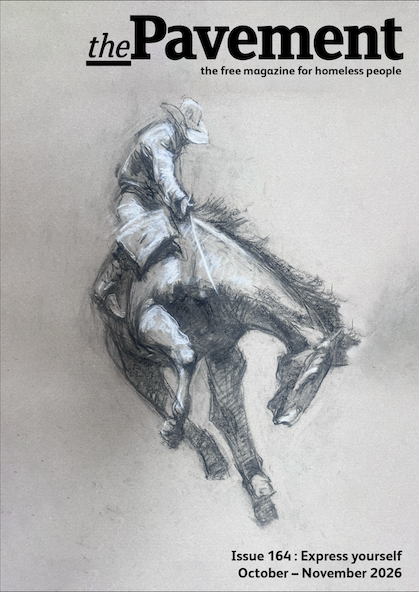
October – November 2026 : Express yourself
CONTENTS
BACK ISSUES
- Issue 164 : October – November 2026 : Express yourself
- Issue 163 : August – September 2026 : Here and now
- Issue 162 : June – July 2026 : Labels
- Issue 161 : April – May 2026 : Working together
- Issue 160 : February – March 2026 : Progress
- Issue 159 : December 2025 – January 2026 : Resolutions
- Issue 158 : October – November 2025 : Making a difference
- Issue 157 : August – September 2025 : Caring about care
- Issue 156 : June – July 2025 : Resilience
- Issue 155 : April – May 2025 : Second Chances
- Issue 154 : February – March 2025 : Time
- Issue 153 : December 2024 – January 2025 : Solidarity
- Issue 152 : October – November 2024 : Change
- Issue 151 : August – September 2024 : Being Heard
- Issue 150 : June – July 2024 : Reflections
- Issue 149 : April – May 2024 : Compassion
- Issue 148 : February – March 2024 : The little things
- Issue 147 : December 2023 – January 2024 : Next steps
- Issue 146 : October 2023 – November 2023 : Kind acts
- Issue 145 : August 2023 – September 2023 : Mental health
- Issue 144 : June 2023 – July 2023 : Community
- Issue 143 : April 2023 - May 2023 : Hope springs
- Issue 142 : February 2023 - March 2023 : New Beginnings
- Issue 141 : December 2022 - January 2023 : Winter Homeless
- Issue 140 : October - November 2022 : Resolve
- Issue 139 : August - September 2022 : Creativity
- Issue 138 : June - July 2022 : Practical advice
- Issue 137 : April - May 2022 : Connection
- Issue 136 : February - March 2022 : RESPECT
- Issue 135 : Dec 2021 - Jan 2022 : OPPORTUNITY
- Issue 134 : September-October 2021 : Losses and gains
- Issue 133 : July-August 2021 : Know Your Rights
- Issue 132 : May-June 2021 : Access to Healthcare
- Issue 131 : Mar-Apr 2021 : SOLUTIONS
- Issue 130 : Jan-Feb 2021 : CHANGE
- Issue 129 : Nov-Dec 2020 : UNBELIEVABLE
- Issue 128 : Sep-Oct 2020 : COPING
- Issue 127 : Jul-Aug 2020 : HOPE
- Issue 126 : Health & Wellbeing in a Crisis
- Issue 125 : Mar-Apr 2020 : MOVING ON
- Issue 124 : Jan-Feb 2020 : STREET FOOD
- Issue 123 : Nov-Dec 2019 : HOSTELS
- Issue 122 : Sep 2019 : DEATH ON THE STREETS
- Issue 121 : July-Aug 2019 : INVISIBLE YOUTH
- Issue 120 : May-June 2019 : RECOVERY
- Issue 119 : Mar-Apr 2019 : WELLBEING
- Issue 118 : Jan-Feb 2019 : WORKING HOMELESS
- Issue 117 : Nov-Dec 2018 : HER STORY
- Issue 116 : Sept-Oct 2018 : TOILET TALK
- Issue 115 : July-Aug 2018 : HIDDEN HOMELESS
- Issue 114 : May-Jun 2018 : REBUILD YOUR LIFE
- Issue 113 : Mar–Apr 2018 : REMEMBRANCE
- Issue 112 : Jan-Feb 2018
- Issue 111 : Nov-Dec 2017
- Issue 110 : Sept-Oct 2017
- Issue 109 : July-Aug 2017
- Issue 108 : Apr-May 2017
- Issue 107 : Feb-Mar 2017
- Issue 106 : Dec 2016 - Jan 2017
- Issue 105 : Oct-Nov 2016
- Issue 104 : Aug-Sept 2016
- Issue 103 : May-June 2016
- Issue 102 : Mar-Apr 2016
- Issue 101 : Jan-Feb 2016
- Issue 100 : Nov-Dec 2015
- Issue 99 : Sept-Oct 2015
- Issue 98 : July-Aug 2015
- Issue 97 : May-Jun 2015
- Issue 96 : April 2015 [Mini Issue]
- Issue 95 : March 2015
- Issue 94 : February 2015
- Issue 93 : December 2014
- Issue 92 : November 2014
- Issue 91 : October 2014
- Issue 90 : September 2014
- Issue 89 : July 2014
- Issue 88 : June 2014
- Issue 87 : May 2014
- Issue 86 : April 2014
- Issue 85 : March 2014
- Issue 84 : February 2014
- Issue 83 : December 2013
- Issue 82 : November 2013
- Issue 81 : October 2013
- Issue 80 : September 2013
- Issue 79 : June 2013
- Issue 78 : 78
- Issue 77 : 77
- Issue 76 : 76
- Issue 75 : 75
- Issue 74 : 74
- Issue 73 : 73
- Issue 72 : 72
- Issue 71 : 71
- Issue 70 : 70
- Issue 69 : 69
- Issue 68 : 68
- Issue 67 : 67
- Issue 66 : 66
- Issue 65 : 65
- Issue 64 : 64
- Issue 63 : 63
- Issue 62 : 62
- Issue 61 : 61
- Issue 60 : 60
- Issue 59 : 59
- Issue 58 : 58
- Issue 57 : 57
- Issue 56 : 56
- Issue 56 : 56
- Issue 55 : 55
- Issue 54 : 54
- Issue 53 : 53
- Issue 52 : 52
- Issue 51 : 51
- Issue 50 : 50
- Issue 49 : 49
- Issue 48 : 48
- Issue 47 : 47
- Issue 46 : 46
- Issue 45 : 45
- Issue 44 : 44
- Issue 43 : 43
- Issue 42 : 42
- Issue 5 : 05
- Issue 4 : 04
- Issue 2 : 02
- Issue 1 : 01
- Issue 41 : 41
- Issue 40 : 40
- Issue 39 : 39
- Issue 38 : 38
- Issue 37 : 37
- Issue 36 : 36
- Issue 35 : 35
- Issue 34 : 34
- Issue 33 : 33
- Issue 10 : 10
- Issue 9 : 09
- Issue 6 : 06
- Issue 3 : 03
- Issue 32 : 32
- Issue 31 : 31
- Issue 30 : 30
- Issue 29 : 29
- Issue 11 : 11
- Issue 12 : 12
- Issue 13 : 13
- Issue 14 : 14
- Issue 15 : 15
- Issue 16 : 16
- Issue 17 : 17
- Issue 18 : 18
- Issue 19 : 19
- Issue 20 : 20
- Issue 21 : 21
- Issue 22 : 22
- Issue 23 : 23
- Issue 24 : 24
- Issue 25 : 25
- Issue 8 : 08
- Issue 7 : 07
- Issue 26 : 26
- Issue 27 : 27
- Issue 28 : 28
- Issue 1 : 01